Mobile Phone Technology
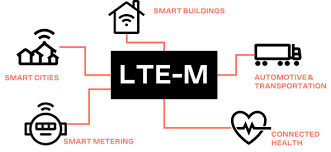
IoT for smart devices can be located anywhere but they need a communication path to the cloud or a server. In an IoT application the data communication is typically small data items which do not need the full 4G / 5G infastructure.
What is needed is a network that :
- Has a low power requirement; LTE-M states that a 5Wh battery should last 10 years
- Applications have a low data transmission requirement
- Transmission is symmetrical, similar data rates required for both upload and download
Applications that could use LTE-M include:
- Smart Cities street lighting, parking management although cameras would put too high a demand on the protocol.
- Agriculture precision farming, soil monitoring, livestock tracking.
- Environmental management gas monitoring (CO2, CO, NO) smoke detectors
- Smart meters which currently are moving to a 4G network with LTE-M.These have low data demand.
- Healthcare and fitness monitoring sensors to heart rate, blood pressure etc.
It is envisaged that LTE-M (or Narrowband IoT) will take over from 2G for many of the critical IoT networks. LTE-M will run on 4G or 5G. The switch away from 2G to LTE-M will be necessary prior to switching off the 2G network.
We may have started to use our mobile phones to make phone calls but now these devices are key to our modern society. We use our mobile phones for directions in a strange city; to access our money through our banking and credit card apps; for tickets to travel whether that is bus, train or air; to watch videos; to take images and buy stuff.
But how does mobile phone technology work? mobilephonetechnology.co.uk seeks to provide information about the technology behind the mobile phone in order to aid understanding and promote more realistic discussions about the technology. Understanding some of the basics of mobile phone technology will help explain how things work and what can and cannot be done with mobile phone technology.
mobilephonetechnology.co.uk is a FREE online resource. Have you found it interesting? You can say thank you and buy me a coffee here. Thank you very much.
w : mobilephonetechnology.co.uk
e :
 Blog
Blog
© mobilephonetechnology.co.uk all rights reserved 2017-2026